

OmniIndex Blog:
Why Sovereignty is the Key to Unlocking Civic AI with Boudica
As someone who works for an AI company, I admit to a natural bias toward the technology. However, that does not mean I like everything about its current trajectory. In fact, I dislike quite a lot.
For example, I believe the vast energy consumption required to run many leading commercial models is unacceptable and shows a complete lack of consideration in their development. Equally troubling is how the entire architecture of many mainstream AI platforms appears to rest on a foundation of intellectual property theft, non-consensual surveillance, and systematic extraction of user data. Coming from an arts background as a former literature researcher and lecturer, I view certain practices as fundamentally inexcusable regardless of legal loopholes. (The destruction of books being right up there.)
Yet, I still believe in the core technology. When done right, AI can enable people to access data in a safe, transparent, and accessible way to unlock insights and democratize knowledge at a level previously impossible.
This brings us to Sovereign AI and the ability to determine where the system is hosted, what data it is trained on, and who is allowed to access it.
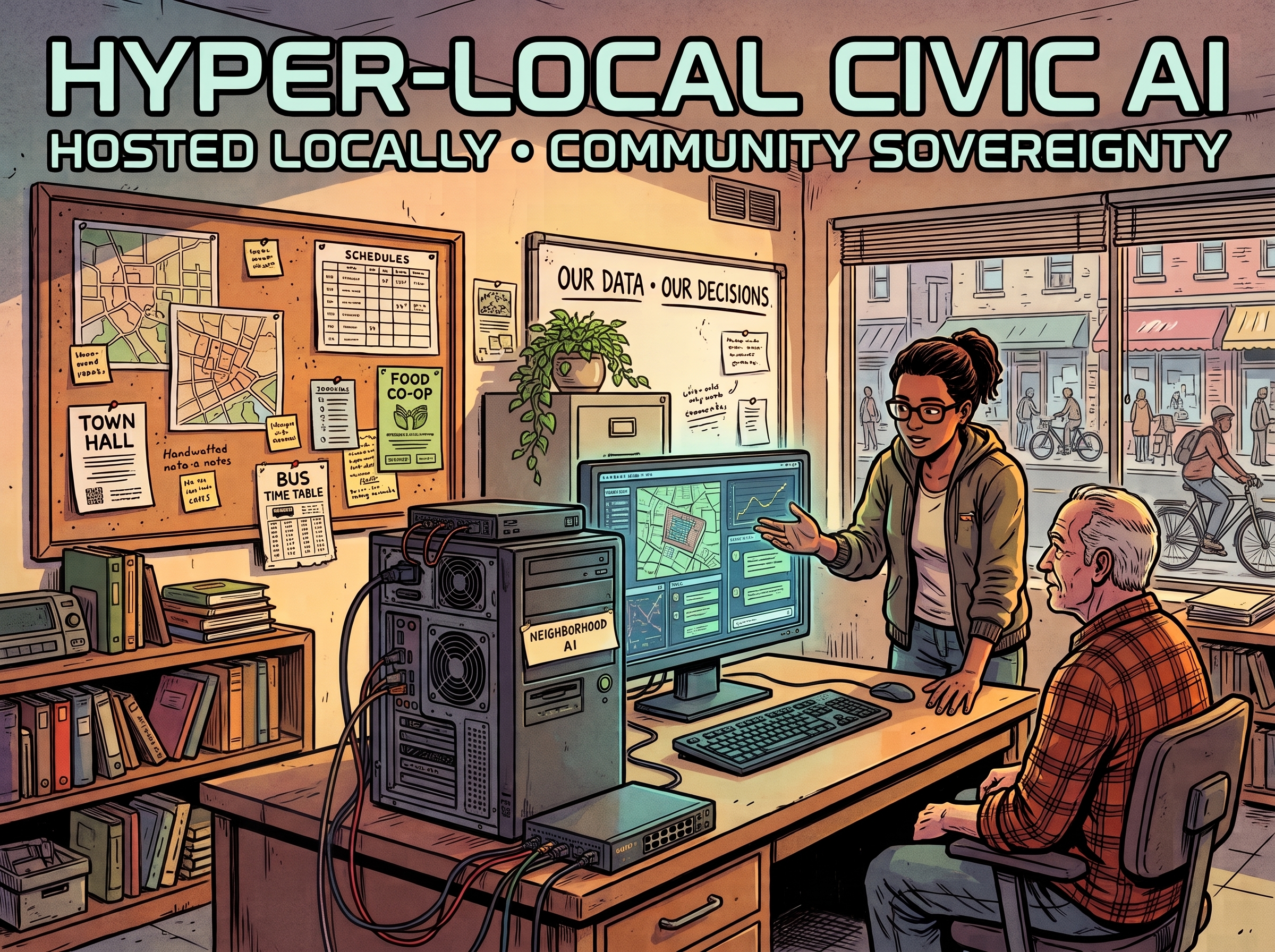
Instead of routing prompts, documents, and private queries to corporate cloud servers in California or China, you run an open-weight model locally on your own infrastructure; sometimes on hardware as simple as a standard desktop gaming PC. You curate the knowledge base, enforce strict privacy controls, scrub personally identifiable information (PII), and maintain complete, immutable audit logs over every answer generated.
When applied to the public sphere, this becomes Sovereign Civic AI: a framework capable of delivering hyper-local intelligence (like Scotland’s Ask Eyemouth project) directly to citizens, visitors, and local council staff without compromising user privacy or surrendering public data to third-party tech giants. And critically, it can be scaled up to as big as you need, and as small for as hyper-local as you need. The decision is yours; as is the control.
The below outlines how we are doing this with the Boudica AI system; focussed on deploying community AI for any scale that gives the owner soveeign control of their intelligence and their data.
Physical & Local Control
Mainstream AI development operates on an unsustainable scaling doctrine: build bigger generalist models, host them in hyper-scale cloud data centers, and run massive GPU clusters continuously regardless of the task complexity. Training a single 175-billion parameter generalist model can generate around 552 metric tons (552,000kg) of CO2.
Sovereign Civic AI flips this wasteful design on its head through domain-specific multi-model architectures.
Instead of routing every trivial query to a massive generalist engine in the cloud, a localized sovereign deployment orchestrates a curated stack of smaller, specialized open-weight models operating locally. For instance, a sovereign setup might deploy the following models all running locally on dedicated hardware: a small 0.6B parameter model for vector embeddings, a fast 8B model for quick retrieval tasks, and a 27B model for complex reasoning.
By hosting hardware locally (whether on an edge PC for a small parish or dedicated local servers for a region), queries execute under flat-rate economics without drawing on distant, over-strained grid infrastructure.
For larger systems, for example the sovereign AI deployed for an entire country, there is a cost and security advantage to being able to deploy it on hardware you control; even when the scale goes far beyond an individual computer. This is because when you own the hardware, you are not reliant on or paying a third-party. This causes costs to become predictable and in-house, and enables you to ensure system maintenance and downtime remain entirely on your schedule, rather than at the mercy of an external cloud provider.
What's more, when it is on your hardware and you are the owner of the AI, you do not need to pay for any token use or place restrictions on your daily queries.
Complete Data Isolation & Zero Telemetry
Commercial cloud AI operates as an extraction engine. Every document uploaded, query typed, or interaction logged is routinely mined to refine proprietary systems or retained under vague provider policies. And even if the provider promises that this is not happening, it is often impossible to verify this due to the 'black-box' nature of the system and the lack of full auditing across the full reasoning and data paths.
Sovereign Civic AI eliminates this surveillance model at the architectural level through zero-telemetry sandboxing:
- No Data Leaves the Perimeter: Prompts, vector embeddings, and model weights are sandboxed locally. Model weights act as static files and physically cannot transmit data across the internet.
- Pre-Inference PII Scrubbing: Before a prompt ever reaches the local inference stack, automated filters strip out any personally identifiable information to prevent accidental data leakage.
- Anonymous Civic Access: Users interact through lightweight public web interfaces that require no user accounts, log no tracking cookies, and collect zero personal data.
- Role-Based Enterprise Isolation: Staff and officials access internal suites using secure, authenticated single sign-on (Keycloak), with access control enforced before vector searching to ensure confidential council files remain restricted.
Intellectual Property and Data Ethics
1. Grounding Knowledge in Approved, Permissioned Data
In a Sovereign Civic AI setup, the AI does not answer public queries by pulling blindly from genric open-web hallucinatory pools. It relies strictly on an Approved-Source Knowledge Base via curated Retrieval-Augmented Generation (RAG).
Local administrators explicitly choose and curate what goes into the system. For example:
- Official parish notices, community announcements, and council minutes.
- Vetted local business listings and regional health timetables.
- Strictly controlled "Allowlist Crawlers" restricted exclusively to designated, approved domain portals (such as official district council sites).
Every answer generated is tied to deterministic citations, allowing citizens and auditors to trace every statement back to the exact local document or approved source chunk.
2. The Base Model Reality
Open-weight base foundation models can inherit training histories derived from broad web datasets. However, sovereignty grants the operator the complete freedom to swap base models as ethical standards evolve and also provide the ability to use their own models when possible.
Hosts can swap out underlying weights without breaking the surrounding civic infrastructure as and when they choose to adopt a new model; for example when a new one becomes available that better suits their needs.
Boudica users have to date chosen a variety of models for their deployments, including Boudica’s own, depending on factors such as the tasks being performed and regional considerations. This includes Mistral and Apertus in Europe, Gemma in America, and Qwen in China.
Model transparency varies considerably. However, there are models available like Apertus that list all their training data and have an open and transparent policy to model developmnet that matches the needs of stricter sovereign deployments.
Reclaiming Our Cognitive Destiny (Verdict)
By shifting execution to locally owned hardware, grounding responses in curated public knowledge, and enforcing absolute data isolation, Sovereign Civic AI transforms artificial intelligence into a genuine public utility.
It gives communities, towns, and nations the ability to preserve their privacy, honor ethical boundaries, and control their own cognitive destiny. And due to the lean architecture and deployment requirements, it can be used by a community as hyper-local as a single in-house knowledge hub for a centre or non-profit by hosting it in the office on a PC, or by one as large as an entire nation through the use of locally controlled data centres and private clouds.
This framework isn't theoretical either. It is already operational in places like Eyemouth, Scotland. Managed by local volunteers, the system provides a privacy-first, zero-advertising digital hub. It ingests local notices, business listings, and council updates, serving as a safe learning assistant for students and older residents alike without a single byte of citizen data being used for anything other than the local AI directory.
So when you are next considering your AI needs, think Sovereign.
Written by Matthew Bain, OmniIndex Head of Marketing.
OmniIndex is owned by Business Partners Limited
All rights reserved © 2026