

OmniIndex Blog:
Renting Vs Owning Intelligence. The Economic Case for Sovereign AI
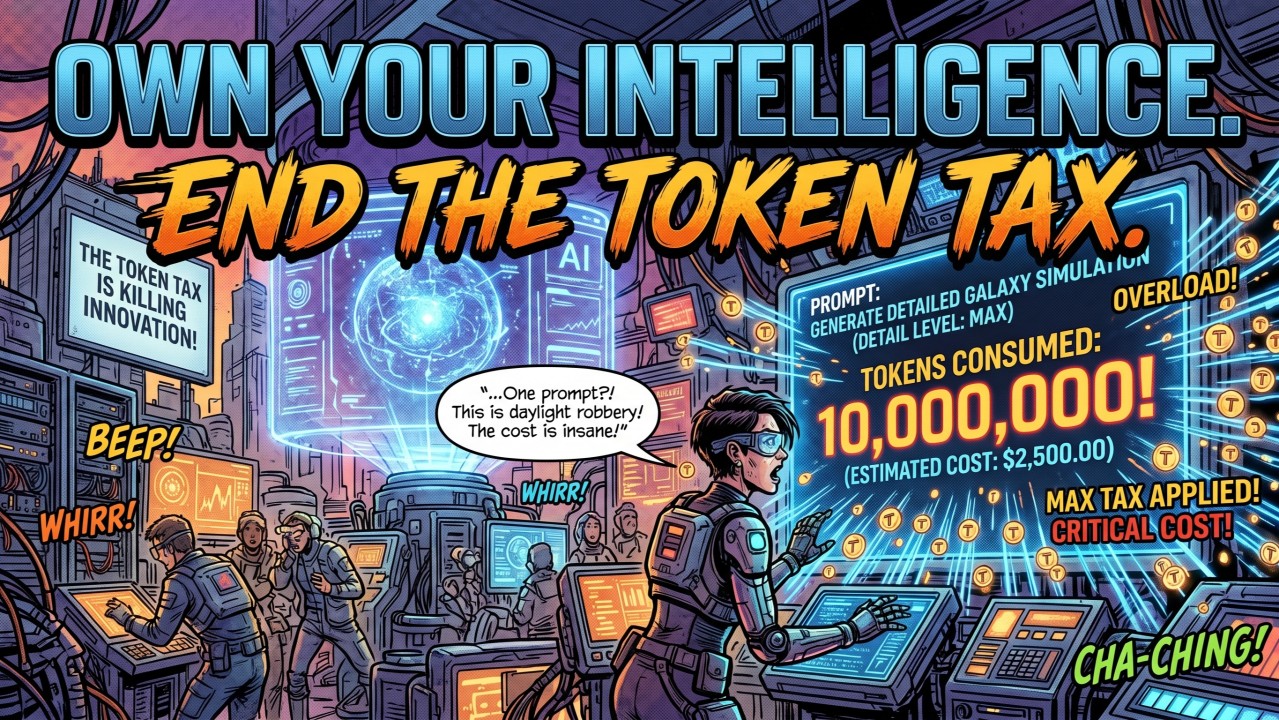
To understand the true cost of artificial intelligence, you have to understand the Token.
A token is the fundamental unit of how your AI conversations are measured with a single token roughly equivalent to four characters or three-quarters of a word (depending on which model you are using). Because of these tiny components that have come to define AI use, data centers are no longer just storage hubs, but ‘Token Factories’ where the primary output is manufactured intelligence measured in these digital fragments.
Yet, for most enterprises, tokens remain a "black-box" mystery. Users interact with a chat interface, unaware of how their prompts are being sliced into tokens behind the scenes. They don't see the thousands of tokens consumed by a single brainstorming session, nor do they see the compounding financial and carbon costs associated with every response generated.
For example, while an average AI interaction is conservatively guestimated to cost apparently 1,000 tokens, if you do this interaction in a pre-existing chat in Gemini (or another LLM) then you suffer a context-tax. This means if you have a "forever chat" with 100,000 tokens of history and you ask a simple 10-token question, the model has to process 100,010 tokens just to understand your new request.
The following table shows the impact of this – based on Gemini’s self-evaluation:

This obscured "Token Tax" is where the economic advantage of Sovereign AI becomes undeniable. By moving to an on-premises, first-hand Sovereign AI architecture like Boudica Torc, you strip away the black box and take absolute control of the expense.
To put it simply, because the intelligence is hosted on your own hardware, the marginal cost of a token effectively vanishes: generating one billion tokens costs you the same as generating one. Therefore, while cloud-based LLMs penalize your growth with linear usage fees, Sovereign AI rewards it…
As you scale your Sovereign AI operations, the per-token value decreases. The complete opposite of
the "rented intelligence" model found in the cloud.
Three Pillars of Intellectual Sovereignty
1. Economic Viability: From Renting to Owning
Renting tokens is a wealth transfer. By moving to an on-premise "First-Hand" AI model, you convert an unpredictable OpEx bill into a high-value corporate asset where you stop paying for "access" and start building "equity" in your own computational power.
2. First-Hand Governance vs. External Control
When you rely on external models, you are subject to External Governance. If a provider changes their "safety" filters, modifies their model’s reasoning (model drift), or deprecates a version, your entire workflow breaks. Sovereign AI means your rules, your guardrails, and your version control.
3. Total Digital Security: Keeping Intelligence In
Digital security is often framed as "keeping hackers out." In the age of AI, security means keeping your intelligence in. By processing intelligence first-hand, you ensure that proprietary R&D and customer data never cross a third-party threshold. As the saying goes: If your data trains a cloud provider's model, you have effectively subsidized your competitors.
Conclusion: Own Your Own Intelligence, Control the Cost.
The choice is simple: Do you want to pay a Token Tax for the rest of your corporate life which scales as you do? Or do you want to own the "brain" of your enterprise and control the cost.
Boudica Torc provides the foundation for this independence. By bringing your AI first-hand and on-prem, you secure your data, your budget, and your competitive future. Don't just rent intelligence. Own it.
Written by Matthew Bain, OmniIndex Head of Marketing.
All rights reserved © 2026 OmniIndex