

IP Protection & Domain-Specific Support for Engineers
Unlike consumer AI tools, Boudica provides the intelligence of modern LLMs without the risks of code leakage or reliance on external APIs.

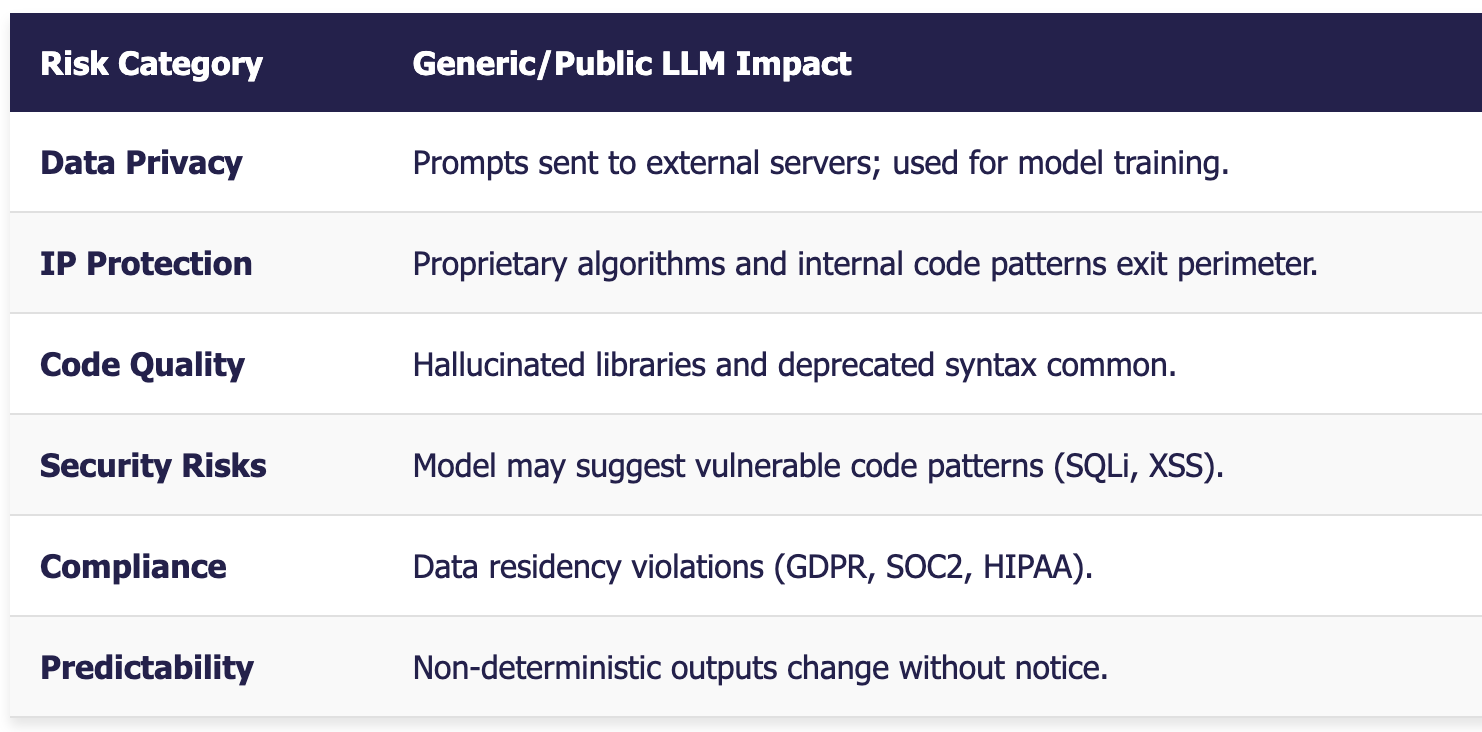
Generic LLMs pose risks to engineering and coding tasks due to their tendency to hallucinate incorrect code, suggest insecure practices, and provide outdated or inaccurate technical information.
Domain-Specific, Sovereign, Intelligence
In the age of AI, your codebase is your most defensible asset. But for engineering teams, code is exactly what you can least afford to expose to a public model that trains on the internet's mistakes. Boudica Torc changes that.
Own Your Own Intelligence.
Key Value Propositions
Zero Data Leakage
No source code, internal docs, or architectural decisions ever leave your network.
Domain Expertise
Trained on your codebase, your patterns, your conventions.
Auditability
Every code suggestion logged for review and defensible lineage.
Cost Predictability
No per-token API fees. Run unlimited queries at your own hardware cost.
Use Cases
Document Grounding:
Code in Context
Architecture Alignment: New code matches the patterns laid out in our internal RFCs and design docs.
Documentation From Code: Generate API references, READMEs, and docstrings grounded in the source files attached to the chat. Documentation stays current with the code.
Targeted Refactoring: Upload a single file, ask for a specific change or optimization (memory, performance, anti-patterns), and get a response grounded in just that file.
Custom Code LoRA Adapter:
AI That Knows Your Codebase
Native LoRA fine-tuning on the OmniIndex codebase covering C++/CUDA, JavaScript, and Python. The model learns from our actual code patterns, not the internet's average.
LoRA Hot-Swap:
Multiple Specialists in One Session
Switch between adapters mid-chat without restart. The general writing adapter handles documentation, the code adapter handles implementation, all in the same conversation.
Engineering Specialist Routing: Infrastructure-Aware Reasoning
Right Tool for the Job: Questions about CUDA, databases, or system configuration go to a model that understands the stack.
Legacy Code Translation: Ask "what does this ten-year-old C++ module actually do?" and get a plain-language explanation grounded in our codebase, not generic web answers.
Faster Triage: Debug queries, dependency lookups ("which services call this function?"), and infrastructure questions resolve in one pass, with no manual picking between adapters.
How OmniIndex Uses This In-House
Trained on the OmniIndex codebase covering C++/CUDA, JavaScript, and Python. Every suggestion matches our memory management, security protocols, and architectural decisions. The adapter improves with every commit added to the corpus.
Generate API references, READMEs, and docstrings grounded in the source files attached to the chat. Documentation stays current with the code rather than drifting over time.
In a single chat session, the general adapter writes a technical whitepaper while the code adapter writes a C++ CGI application against the same context. Hot-swap latency is sub-microsecond. No monolithic LLM can do this in one session.
Our OmniIndex Engineering specialist takes a question like "what does this ten-year-old C++ module actually do?" and returns a plain-language explanation grounded in our codebase. Onboarding into legacy areas drops from weeks of confusion to minutes.
Every AI suggestion that influences code is logged. When a security issue surfaces, SQL back-tracing shows the exact suggestion and context that informed the change.
All rights reserved © 2026 OmniIndex