

CEO Simon Bain:
Why The Future of Cybersecurity Depends on 'Intrinsic Security'
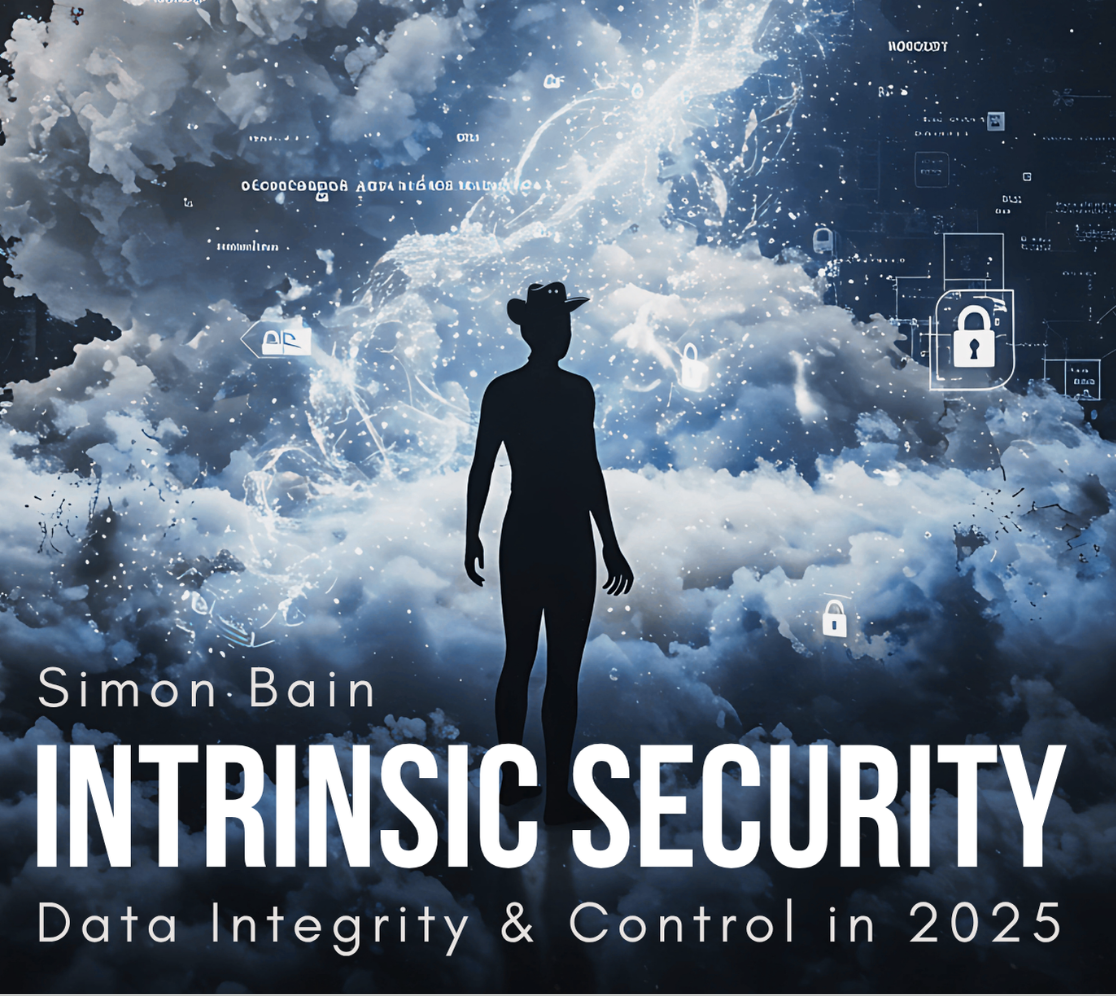
In an era defined by sprawling cloud workflows, third-party SaaS apps, and rapid AI adoption, legacy security models are falling short. Organizations spend billions on bolted-on firewalls and perimeter tools, yet data breaches continue to skyrocket. Why? Because traditional IT treats security as an extra layer applied on top of systems rather than an inherent property built into the data itself.
In his free e-book, "Intrinsic Security: Data Integrity & Control," our CEO Simon Bain argues that it is time for a fundamental paradigm shift. Security must become "intrinsic": an architecture where data protection is native, continuous, and the direct responsibility of system developers rather than end-users.
Key Concepts from the Book
1. The Unbreakable Chain (Blockchain & Hybrid Systems)
Traditional databases allow privileged users or bad actors to edit or delete audit logs and sensitive records. By applying corporate, private hybrid blockchain architectures, data becomes immutable. Updates create distinct, cryptographically linked versions rather than overwriting original files, generating an automatic, tamperproof audit trail natively.
2. Zero-Trust Access & System Responsibility
For decades, security breaches have been blamed on "user error". Bain shifts this burden back to developers: systems must be built "secure by design". Adopting a strict Zero-Trust approach ("never trust, always verify") ensures that access is continuously validated at a granular level, reducing the "blast radius" of any potential compromise.
3. "Not Your Keys, Not Your Data" (Sovereign Data Control)
If a third-party cloud vendor or AI platform holds your encryption keys, you don't truly own your data. Bain outlines dynamic key derivation methods where encryption keys are generated on-demand locally, eliminating vulnerable centralized "key stores" or wallets.
4. True Privacy Through "Never Decrypt" (Fully Homomorphic Encryption)
The biggest dilemma in data analytics is the exposure risk when decrypting sensitive information to run queries. Through Fully Homomorphic Encryption (FHE), analytics and machine-learning searches can be run directly over encrypted binary patterns, yielding accurate results without ever exposing the raw data.
5. Native, Private AI for Unstructured Content & Threat Intelligence
From sprawling file repositories to massive log files, external public AI models present severe data leak risks. Embedded, private Small Language Models (SLMs)—like OmniIndex's Boudica AI—allow organizations to perform semantic search, automated PII redaction, and proactive threat hunting safely within their own secure boundaries.
The Takeaway
Security cannot remain a reactive, bolted-on product. By combining immutable Web3 storage, Zero-Trust access, user-held keys, FHE, and native private AI, Intrinsic Security offers a blueprint for an architecture where data is secure by existence, allowing organizations to innovate confidently without exposing their most valuable assets.
Written by Matthew Bain, OmniIndex Head of Marketing.
All rights reserved © 2026 OmniIndex