

OmniIndex Blog:
Beyond Knowledge Cutoffs: Why Live-Scraped RAG is the Future of Enterprise AI
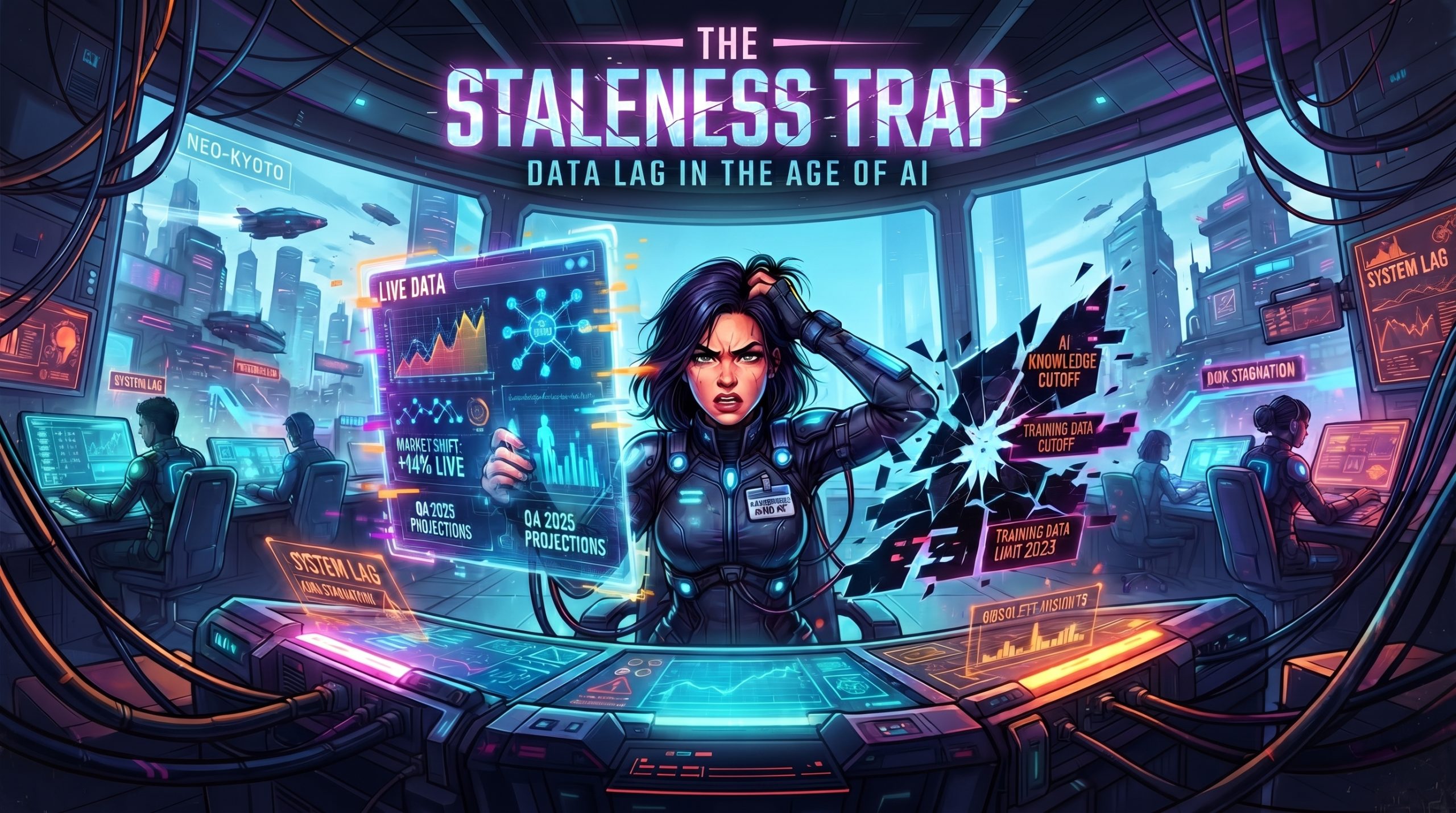
How often do you get an email from someone about your company or some work you're doing, and roll your eyes at how irrelevant it is? Not necessarily because it is completely wrong (though sometimes it is!), but because its talking about something from 6 months ago.
In my role at OmniIndex, I get this constantly. Why? Because at the start of the year we did a full website reset with our new emphasis and the AIs have taken a long time to catch up. As such I get cold emails talking about loving my 'new white paper' that was published 3 years ago and is no longer relevant, or telling me how good it was to see me at a show in Berlin I didn't go to this year.
Whether it's called temporal drift, model decay, or simply "staleness," this frustration is caused by static AI training where the moment a base model finishes training, its memory begins to age.
This problem is especially acute for enterprises requiring digital sovereignty as whether using open-source architectures or proprietary models developed in-house, these self-hosted solutions can lag behind live events while teams wait for new model iterations to stabilize.
To bypass staleness, many enterprises deploy autonomous agents that actively sweep the web for updates, but in sovereign, high-stakes environments, this open-ended autonomy creates unacceptable liabilities; including catastrophic data exposure, unmonitored third-party API interactions, supply chain leakage, and runaway operational costs. And even if the data is actually live, a user cannot be sure of this because of the unauditable nature of mainstream AI and the fact a user cannot see the full reasoning path to verify an answer.
While this is okay for some uses, in high-stakes regulated environments it is unacceptable.
Instead of giving AI agents unmonitored access to the open web, enterprises need a curated, architecturally isolated pipeline where humans stay in control of what enters the environment. That’s where targeted Retrieval-Augmented Generation (RAG) comes in. By powering RAG with continuous, agile web and document scraping, you get a live, verifiable stream of intelligence tailored precisely to your organization.
The Enterprise Blueprint: Custom, Grounded, and Agile
By pairing targeted web scraping with a vector-indexed RAG pipeline, enterprises can bypass static limitations entirely within their required specialist domain. This is because the AI routinely ingests, chunks, and vectorizes real-time updates from target digital environments, grounding every response in verifiable, authoritative truth.
The following examples show how live-scraped RAG transforms enterprise AI from a static & stale chatbot, into an essential business engine:
The Internal Knowledge Engine
- The Source: Internal Git repositories, company intranet pages, technical user guides, and internal wikis.
- The Value: Engineering and support teams frequently deal with "documentation drift" where the product evolves faster than the internal manual. By continuously scraping internal code repositories (commit logs, READMEs, pull requests) and internal site updates, the company's internal RAG assistant becomes a single source of truth.
- The Outcome: Developers and customer support teams get instantaneous answers that reflect code merged five minutes ago, completely eliminating time wasted searching through deprecated docs or acting on obsolete internal procedures.
Continuous Industry & Regulatory Intelligence
- The Source: Industry regulators, trade associations, specialized news outlets, and market monitors.
- The Value: In highly regulated industries like fintech, healthcare, or global logistics, compliance standards change rapidly. A continuous RAG ingestion pipeline constantly monitors a defined set of trusted regulatory and industry websites to give the company a curated and accurate live resource.
- The Outcome: The enterprise AI acts as an always-on sentinel. Risk management and legal teams can query the system knowing it incorporates the latest policy changes announced this morning, ensuring strategies and operational advice remain strictly compliant without requiring manual policy audits.
The Pop-Up Task Force
- The Source: Competitor product launches, event-specific sites, press coverage, and vendor catalog updates.
- The Value: An agile enterprise needs temporary intelligence for time-sensitive projects; including analyzing a competitor's sudden product unveiling or prepping for a high-stakes vendor negotiation. To do this, the company deploys a targeted scraper across 20 relevant competitor or supplier websites to feed a dedicated, temporary RAG pipeline.
- The Outcome: Strategy teams gain immediate, granular query access over real-time market shifts for the duration of the project. Once the strategic pitch or analysis is complete, the temporary index is purged, keeping the data clean, efficient, and cost-effective.
Boudica AI: Controlled Web Ingestion in Action
Boudica AI is OmniIndex's own sovereign AI Platform. Within the Admin controls there is a Web Crawler so specific URLs can be added to the RAG.
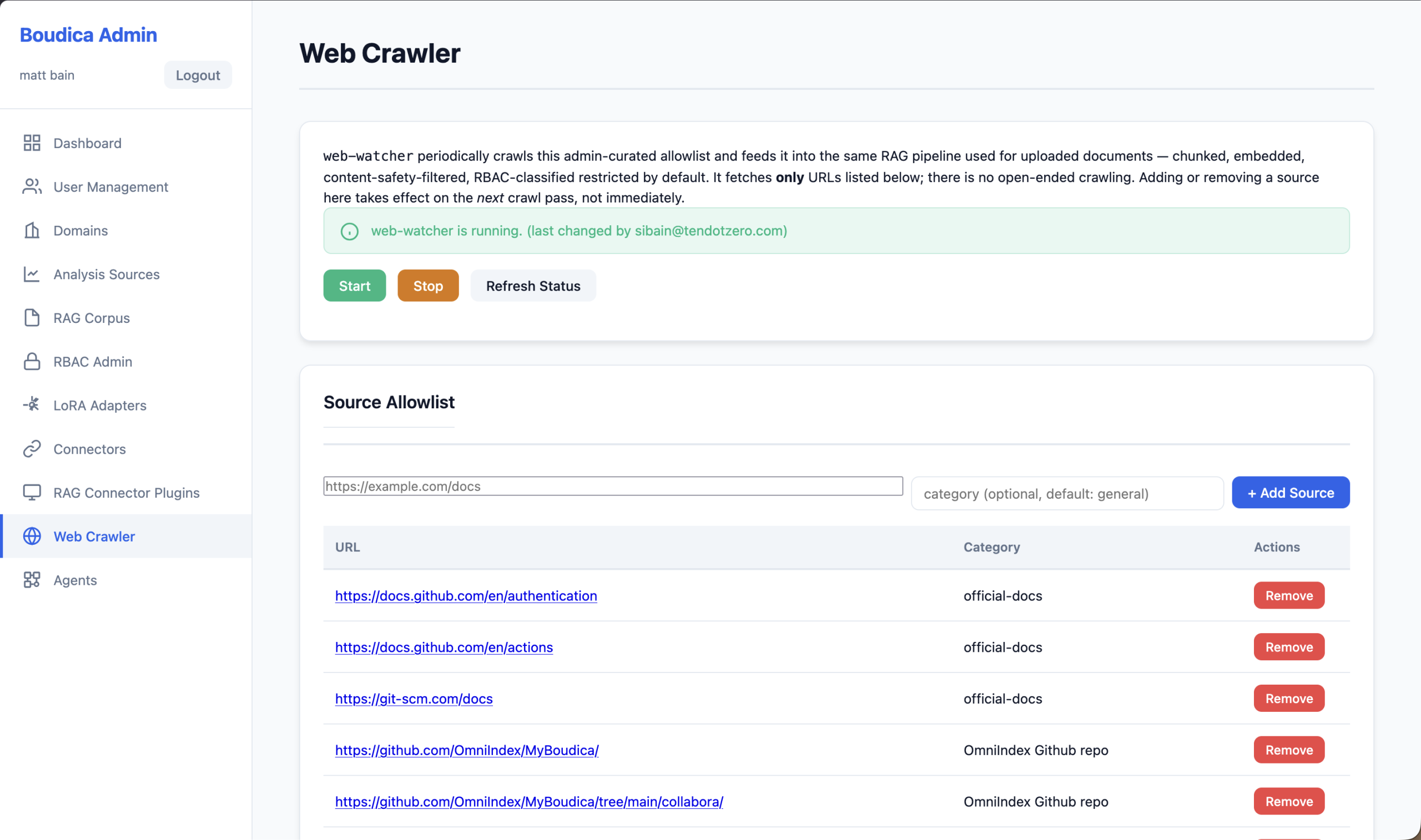
As can be seen in the screenshot of ‘Web Crawler’ in the Boudica Admin portal, one of the authorized URLs included in the RAG pipeline in this example account is OmniIndex’s own Github repositories. This is to help keep the information live and current for tech support, training purposes, and for the generation of marketing material.
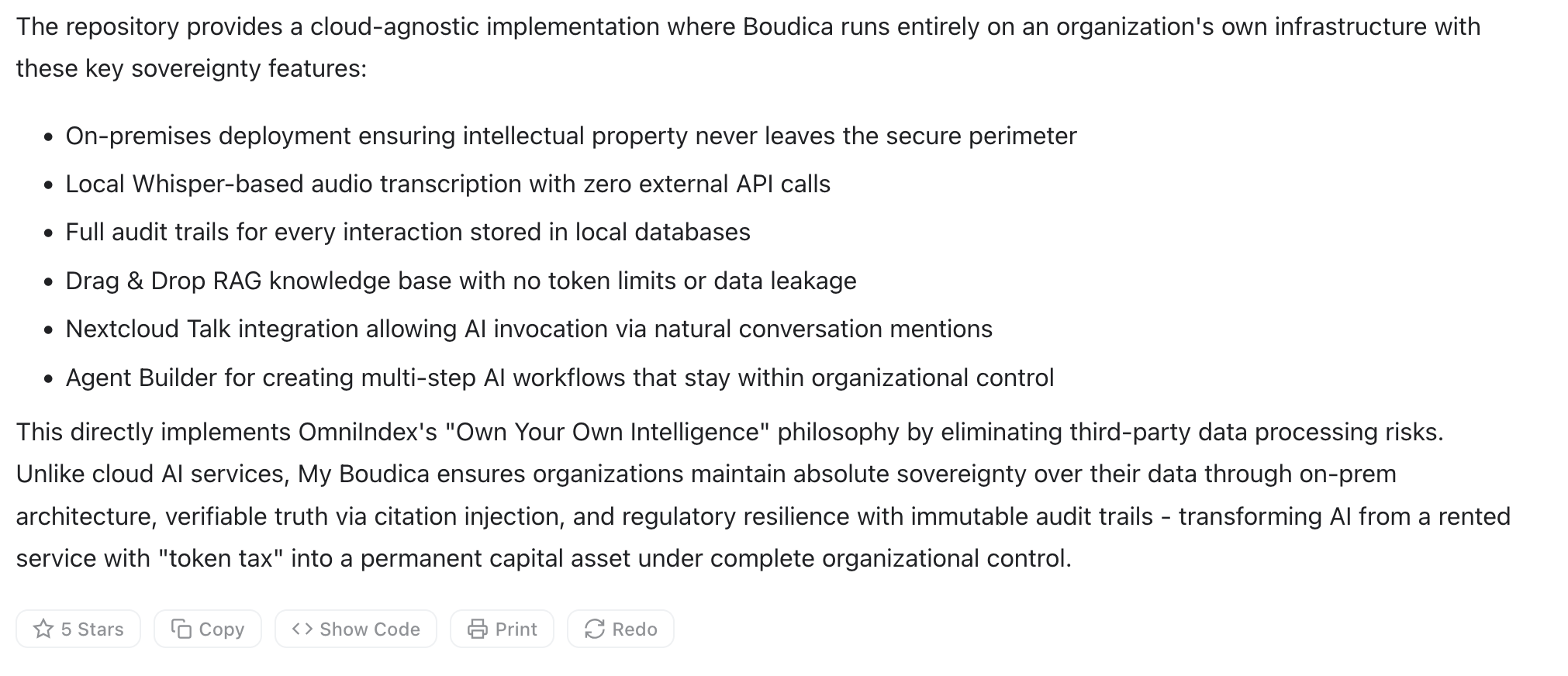
The prompt ‘Using OmniIndex Github repo, Web Crawler. What is 'My Boudica'? Summarize, and explain in relation to AI sovereignty’ takes this information and gives the following reply:
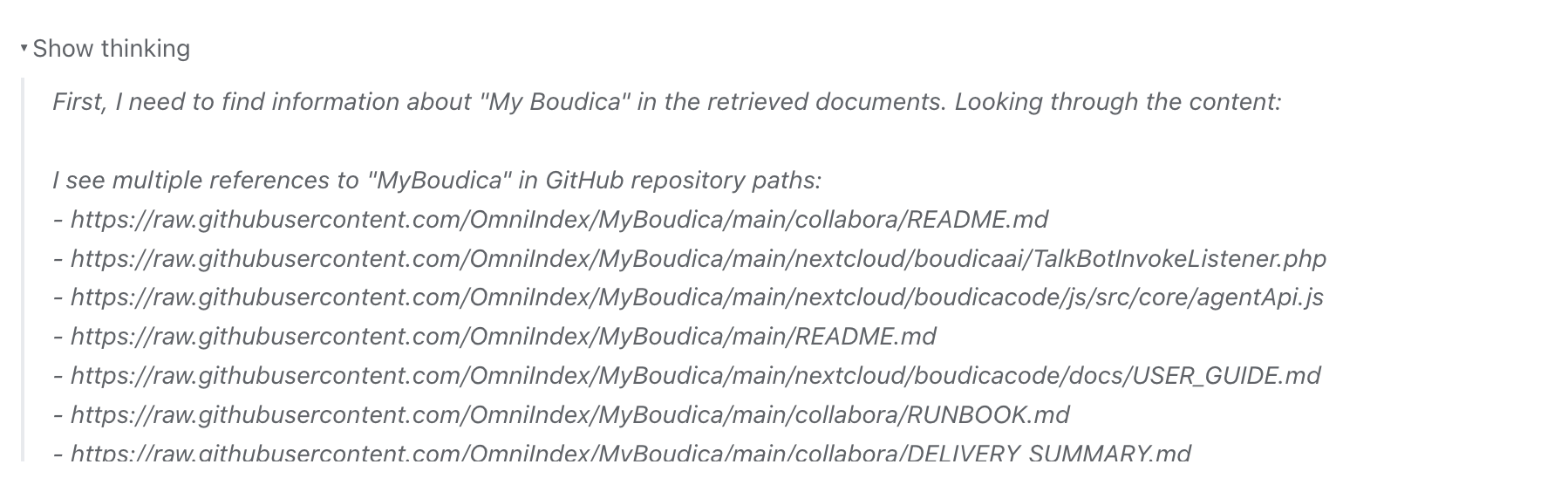
Critically, a user is then able to check the response by looking at Boudica’s ‘thinking’ to see what sources it has pulled from and to ensure it has understood the intent behind their query. This is important because it ensures a user can verify the answer by checking that the response has been grounded in the content desired, not a hallucinated ‘best guess’.
With this particular query, however, I have not just asked for a summary from those sources but for an additional explanation of how this relates to ‘Sovereign AI’.
Rather than simply giving a generic understanding of digital sovereignty or pulling from a ‘best match’ blog found online, the AI considers the context of why it is being asked and seeks out relevant content from the RAG and past conversations.
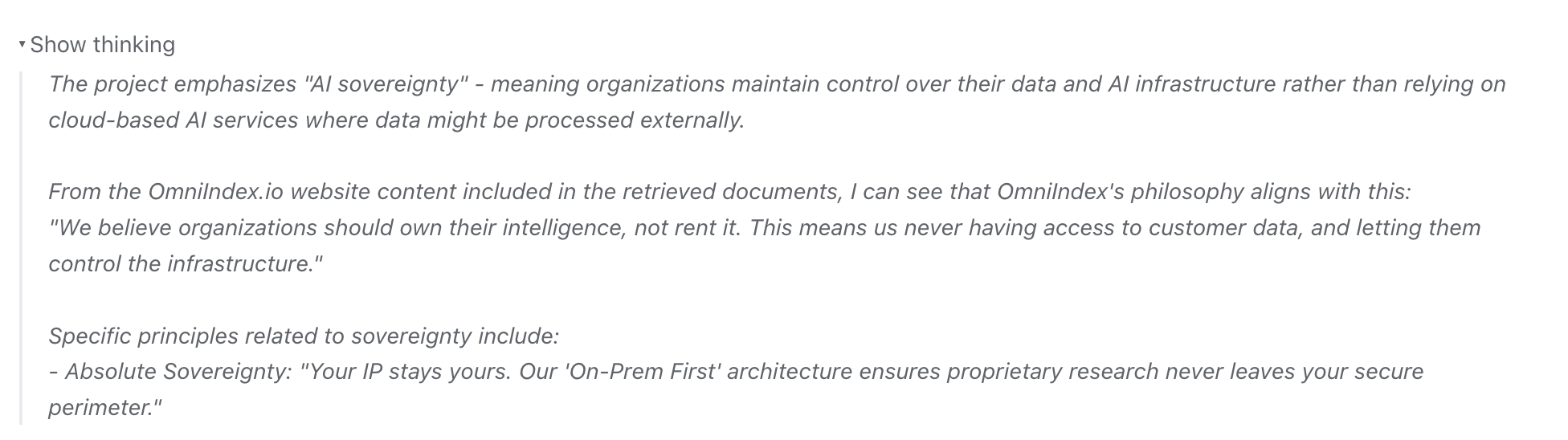
This query and the model reasoning are available both directly in the chat itself, and in the Audit Dashboard. This means as well as immediate verification, the answer can also be reviewed later for governance as well as performance reasons. The captured information also includes the data and time of the query, as well as which model was used for the reasoning and performance metrics including the response speed and how many tokens were generated.
Final Thoughts: Verifiable Intelligence Over Generic Echoes
The future of enterprise AI isn't about owning the largest base model; it's about mastering contextual agility.
By shifting from static knowledge bases to automated, continuous web scraping, organizations ensure their AI is never trapped in the past. And when coupled with domain-specific RAG based on uploading your own files and folders for curated company intelligence, this addition of curated, real-time data streams delivers what enterprise leadership actually needs: a living intelligence that is precise, actionable, and fully verifiable.
Written by Matthew Bain, OmniIndex Head of Marketing.
All rights reserved © 2026 OmniIndex