

Precision & Sovereign Control for Operational Data
Grounded Data Intelligence: Where Precision Outweighs Probability.

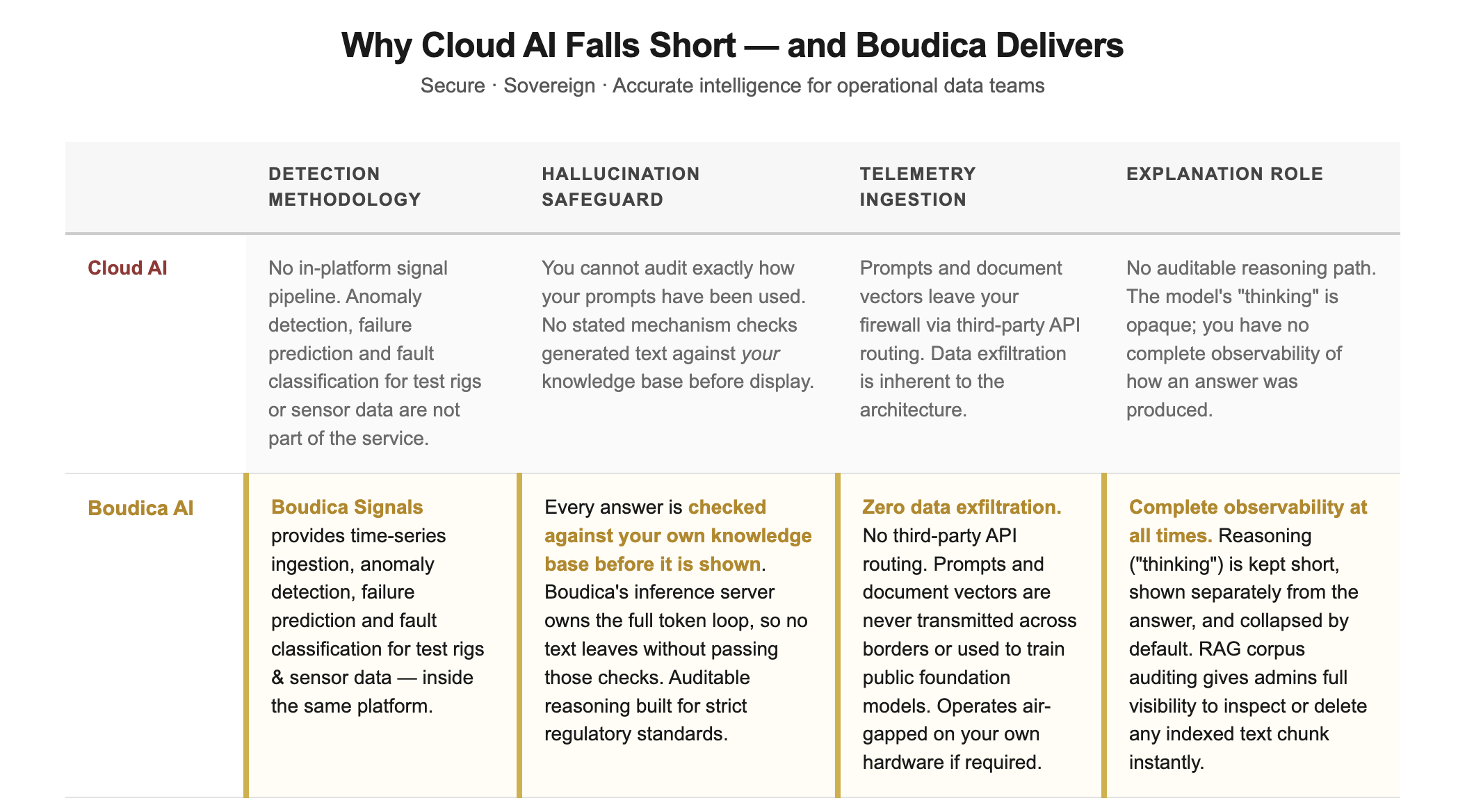
Standard AI Models rely on probabilistic next-token predictions, making them fundamentally prone to numerical hallucinations, false alarms, and ungrounded mathematical claims.
When applied to real-time industrial telemetry, mission-critical hardware loops, intensive care feeds, or high-frequency financial ledgers, these errors introduce catastrophic operational risk.
Intelligence Grounded in Your Data.
The Boudica AI Platform solves this through a strict architectural separation of duties to ensure verifiable accuracy for the most high-stakes data.
Own Your Own Intelligence.
The Architectural Decoupling: Explainer ≠ Detector
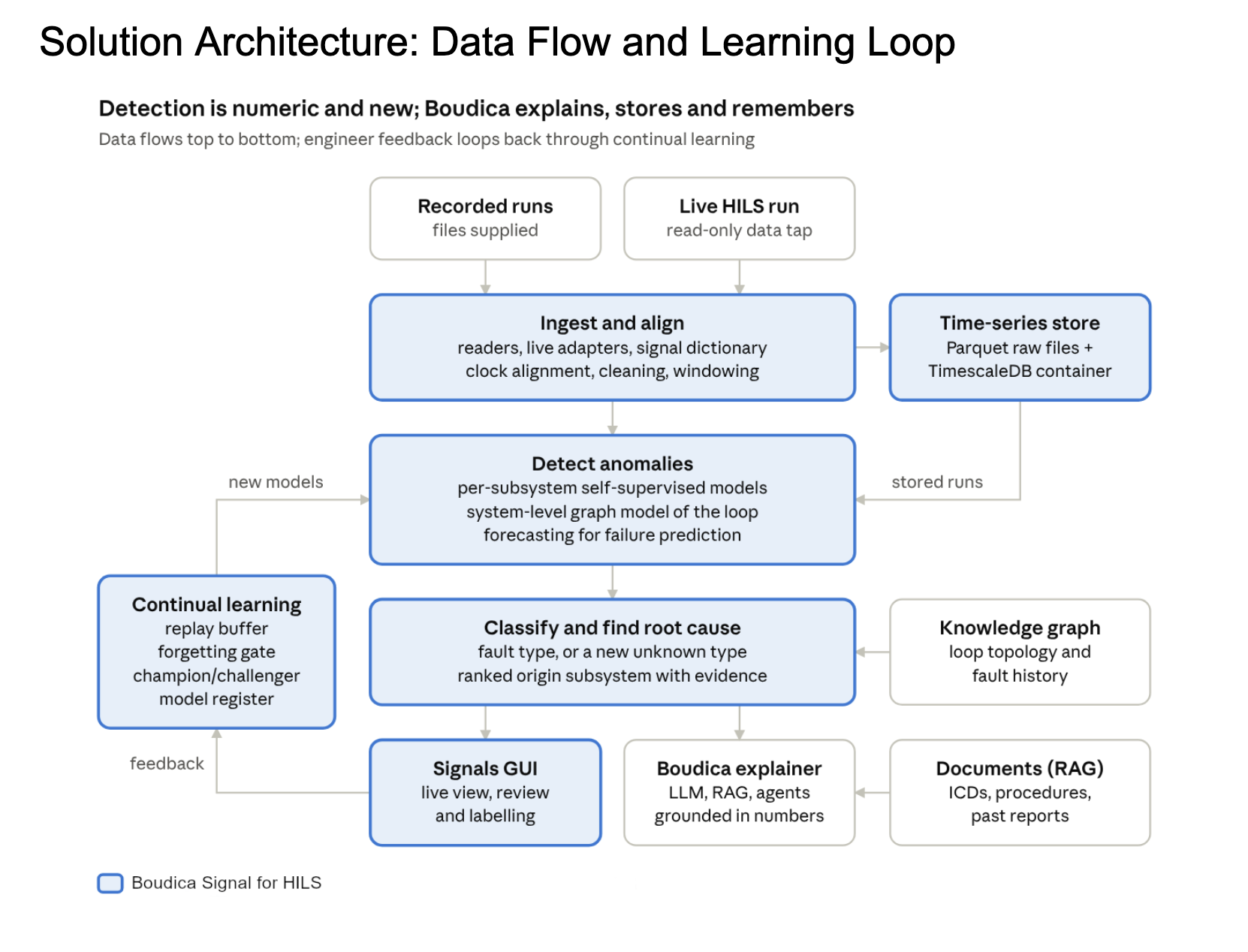
Instead of forcing a probabilistic language model to compute anomaly mathematics, Boudica pairs specialized numeric detector ensembles with an air-gapped language model acting strictly as an auditable translator:
The Specialist Numeric Ensemble (The Detector)
Deterministic, self-supervised models execute speed-critical anomaly classification, root-cause ranking (RCA), and time-to-threshold forecasting. A multi-tier processing hierarchy (Isolation Forests, PCA, temporal autoencoders, and Graph Deviation Networks) flags immediate faults, monitors multi-signal relationships, and forecasts breaches before physical failures occur.
The Natural Language Model
(The Explainer)
The language model never computes anomaly scores or statistical rankings on its own. It strictly translates verified residual arrays, causal-graph nodes, and forecast timelines into diagnostics for engineering and executive personnel in the language(s) you need.
Automated Numeric Grounding Safeguard
Every figure, threshold, and operational timeframe generated by the AI is automatically checked against the specialist detector output. If a figure is not present in the verified numeric evidence, the system rejects it immediately.
Native Multi-Format Ingestion
Boudica processes raw enterprise telemetry without conversion bottlenecks:
Recorded Batch Formats:
Native ingestion of CSV, MATLAB .mat, ASAM MDF4, NI TDMS, HDF5, and Apache Parquet.
Live Streaming Protocols:
Real-time ingestion over UDP/TCP, CAN bus, MIL-STD-1553, ARINC 429, dSPACE, NI VeriStand, and OPAL-RT
No-Code Configuration:
Map complex hardware environments and closed loops through project-level YAML/JSON signal dictionaries defining limits, units, and channel mappings.
High-Stakes Industrial & Enterprise Applications
Defense & Aerospace Test Rigs (HILS)
Monitor ARINC 429 and MIL-STD-1553 signals during Hardware-in-the-Loop simulation, predicting signal limit breaches 15+ seconds in advance and generating plain-language incident reviews.
Cyber-Physical Plant Security
Monitor multi-channel sensor arrays across power generation and chemical facilities, correlating anomalies with local Interface Control Documents (ICDs) without cloud exposure.
Fleet Predictive Maintenance
Ingest CAN bus telemetry from transport fleets to detect early hydraulic and mechanical wear, automatically drafting work orders in the My Boudica Office suite.
High-Frequency Algorithmic Compliance
Evaluate high-volume Parquet transaction streams to detect market manipulation patterns or rapid portfolio drift, compiling audit-ready compliance filings.
ICU Clinical Telemetry
Process multi-parameter physiological feeds (heart rate, blood pressure, oxygenation) to alert clinical staff to impending septic shock or respiratory failure minutes before alarm thresholds are breached.
Related Research & Articles
OmniIndex is owned by Business Partners Limited
All rights reserved © 2026