

OmniIndex Blog:
Interval Vs. External AI: Why Your Company Data Must Stay Where It Is.
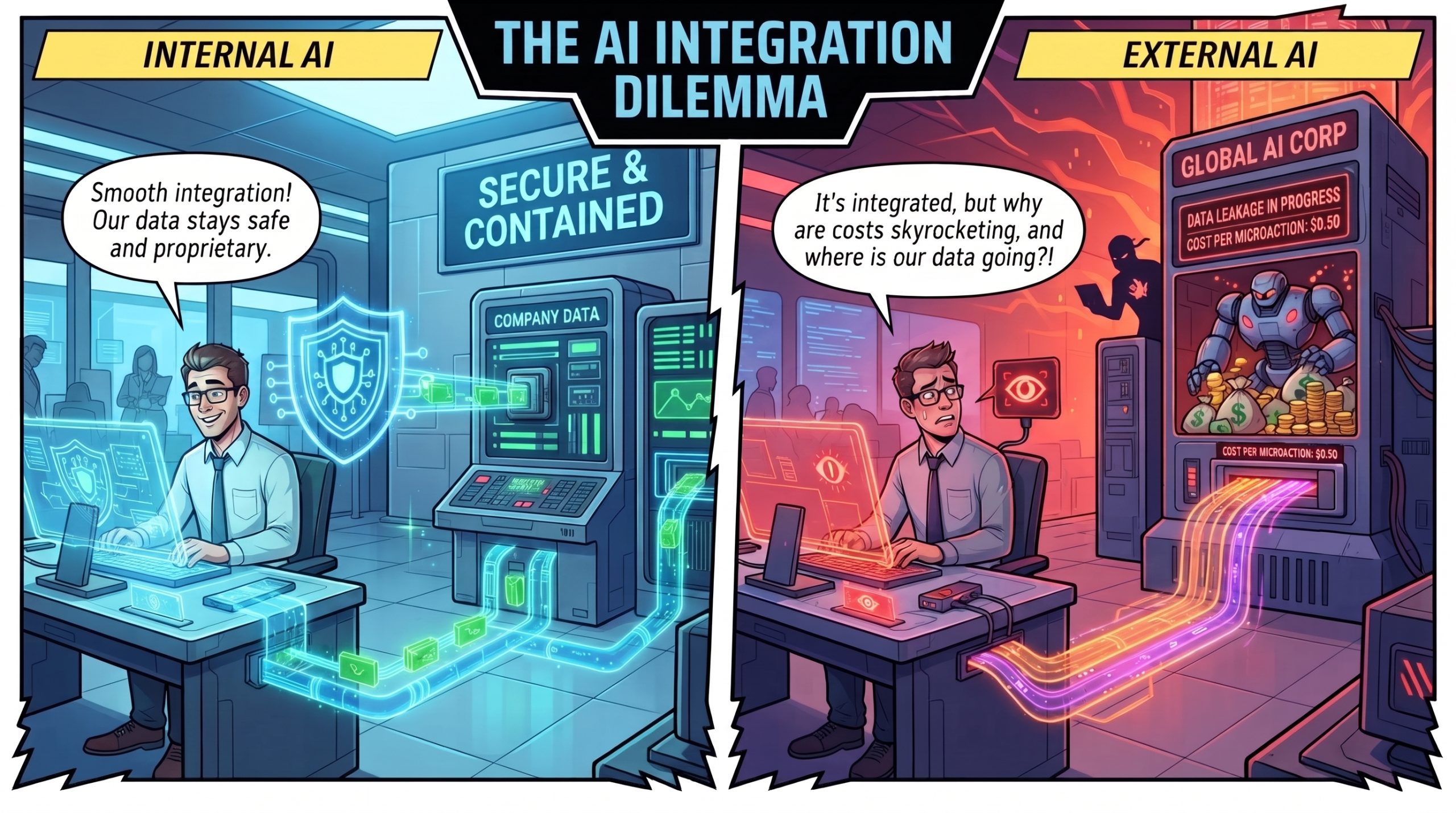
Too often AI is talked about as a revolution. Something entirely new that can come in and transform your workflow with automation and generative power.
But automation of what? Generation of what?
If you do not have that data foundation for the AI to work with, then there is limited enterprise value in it. Why? Because without your own data, your own intelligence, it's just the same tool that everyone else is using producing the same generic stuff while expensively sending your data outside of your secure walls.
As such, AI is best seen as an internal corporate Add-On to an existing stack. And when you are incorporating a new intelligence layer into something already established that contains all of your company content, your data must stay where it is. There can simply be no compromise when it comes to control, cost, or security: it has to be sovereign.
Native Embedding: AI as a Toggleable Utility
Generative AI provides the most value when used as an on-demand intelligence layer built into everyday software, rather than a standalone system trying to replace human expertise. Packaging the engine as local microservices that plug directly into existing stacks via simple REST endpoints turns natural language queries and AI chatbots into simple features within standard workflows.
Operating as a toggleable utility, the AI can be turned on or off without external dependencies or infrastructure shifts. Users query databases in plain language, analyze complex trends, and parse unstructured records while the core software remains completely unchanged.
Critically, this does not mean relying on a fleet of agents to manage, process and automate the tasks. Instead, it is the trained, expert, employees with a physical human in the loop.
Unlocking Operational Efficiency with Zero Data Leakage
Connecting internal pipelines to public, cloud-hosted LLMs exposes sensitive client information and proprietary business data to public API streams. Sovereign AI eliminates this risk by hosting the entire engine within the organization’s owned infrastructure.
- Complete Air-Gapped Deployment: Deploys 100% on-premise or within private sovereign cloud VPCs, ensuring protected data never leaves the security perimeter.
- No Third-Party API Exposure: Keeps sensitive organizational records completely isolated from public training sets or multi-tenant cloud environments.
- Practical Unstructured Data Parsing: Curators and staff input messy, free-text observations or raw field notes, while the native engine automatically categorizes entries, updates logs, and resolves legacy terminology in real time.
- Archival Digitization: OCR capabilities parse handwritten legacy records or historical scans directly into clean, structured database formats within seconds.
Eliminating the Token Tax
Relying on external API services forces organizations into unpredictable, per-token cloud costs that balloon rapidly as query volumes scale.
Running sovereign AI inference on local, fixed-capacity compute assets removes variable token pricing. This guarantees total cost predictability for internal IT departments and allows software vendors to launch high-margin, scalable AI add-on modules across the workflow including agentic workflows and task automation all at the same fixed price.
Scientific Rigor & Compliance-Grade Audit Trails
For AI to be reliable in high-stakes operational environments, automated outputs must be fully accountable. Native sovereign AI combines Retrieval-Augmented Generation (RAG) and Low-Rank Adaptation (LoRA) fine-tuning to deliver precise performance grounded in actual organizational records.
- Immutable Lineage Tracking: Cryptographically logs every generated insight, prompt, active adapter, and retrieved document chunk to construct a transparent audit trail.
- Verifiable Source Citations: Generated outputs provide direct, click-to-verify citations linked to underlying source records, ensuring operational integrity and full academic verifiability.
- Granular Session Observability: Captures local, encrypted logs of user interactions, timestamps, retrieved document IDs, and manual overrides for strict regulatory compliance.
The Bottom Line
By embedding sovereign AI directly into native data platforms, organizations gain the full speed and accessibility of natural language querying while retaining absolute control over their data path, privacy, and cost structures. And critically, the AI becomes part of their product and part of their company value. It is not dependent on a third-party, nor is it risking boosting the AI company’s value through inadvertently training their own model.
Written by Matthew Bain, OmniIndex Head of Marketing.
All rights reserved © 2026 OmniIndex