

Customer Insights:
Sovereign Intelligence by Design: How Boudica AI Preserves Knowledge
Integrity in High-Stakes Governance
Deploying a public-facing AI assistant over high-value intellectual property presents a fundamental architectural dilemma. Standard generative AI pipelines rely on features that expose proprietary research to third-party leakage while introducing the risk of fabricated outputs, including: external APIs, persistent telemetry, and probabilistic text generation. For an authoritative knowledge hub, even a single hallucinated statutory interpretation or unverified claim can undermine institutional credibility and trigger downstream compliance failures.
Achieving true reliability in high-stakes domains requires shifting from probabilistic chat wrappers to deterministic, sovereign containment. Rather than bolting security controls onto an open model after deployment, the underlying architecture must enforce strict boundaries over where data resides, how queries are processed, and how responses are grounded before a single token is returned to the user.
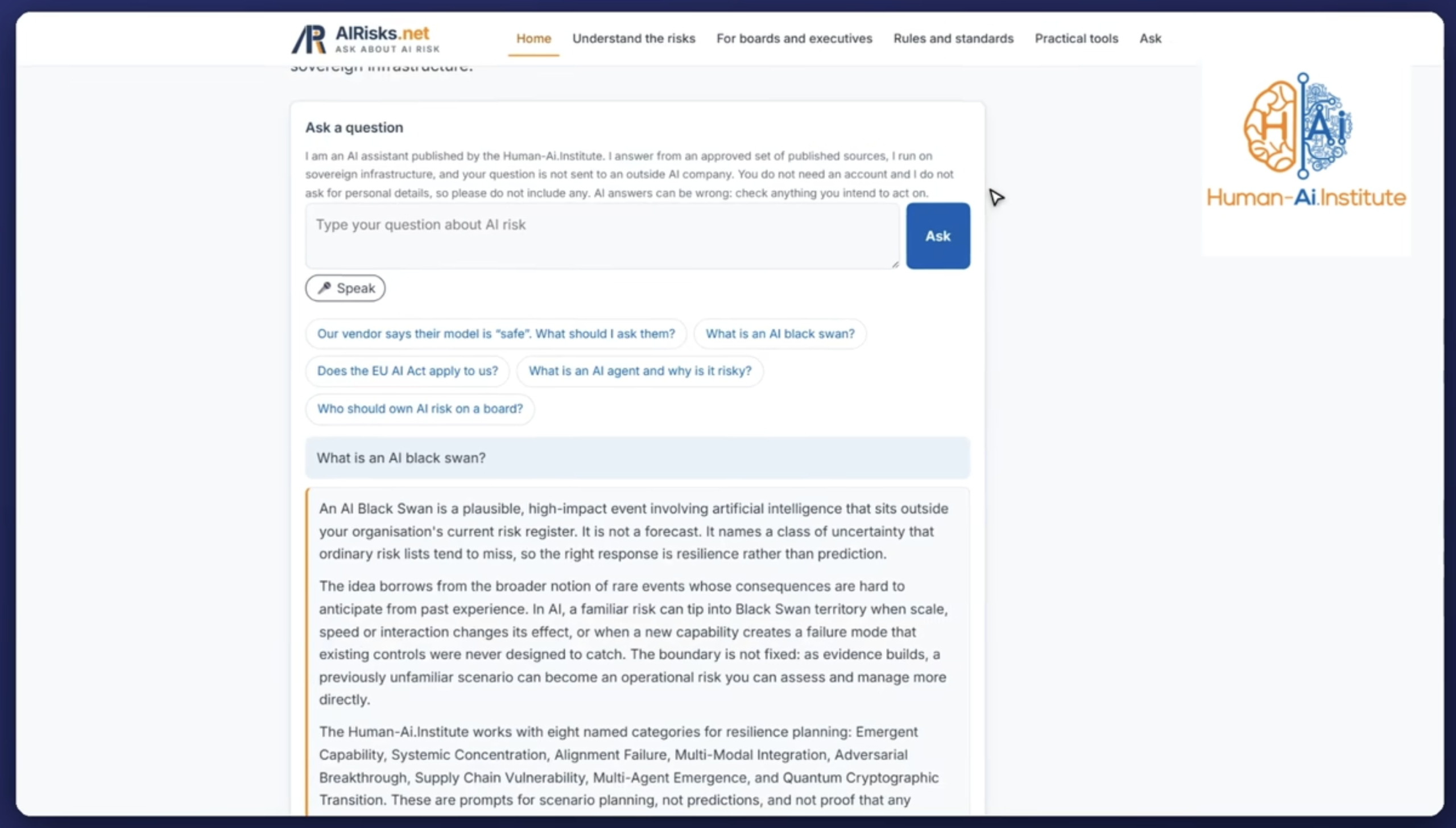
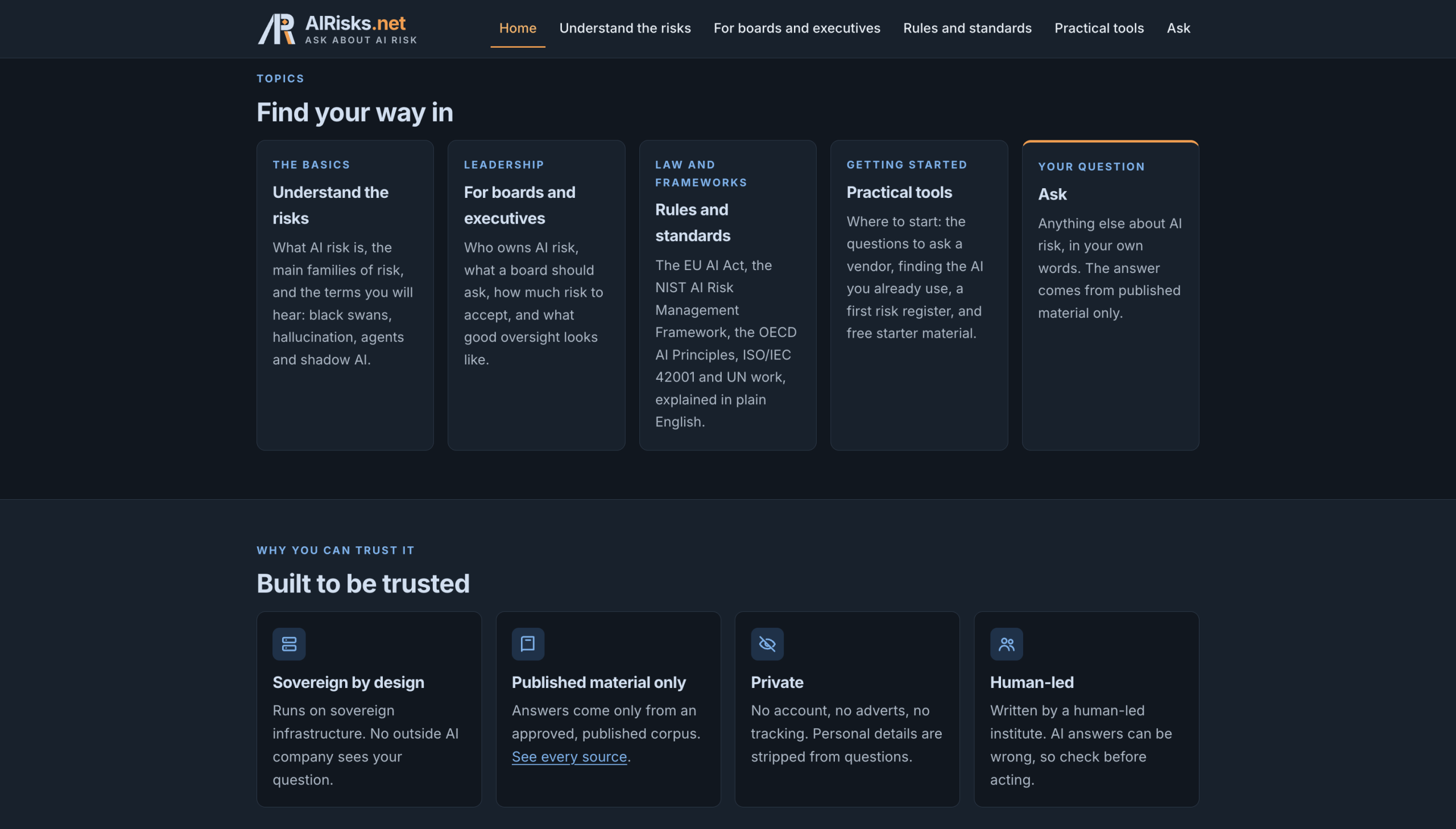
This architectural imperative led The Human AI Institute to partner with OmniIndex to deploy Ask AIRisks (my.airisks.net): an open-access, digitally sovereign AI assistant engineered to translate dense regulatory , ethical , and risk management texts into verifiable , plain-English guidance. Because the Institute advises enterprises and regulators on responsible AI decision-making, its own public knowledge hub demands the highest standards of verifiable data integrity, zero-hallucination retrieval, and strict digital sovereignty; all while remaining agile enough to update rapidly and serve public queries at scale.
Built on OmniIndex’s Boudica AI platform, Ask AIRisks was deployed in a matter of hours, proving that organizations can expose authoritative knowledge hubs to the public without sacrificing intellectual property control, user privacy, or deterministic answer accuracy.
The Ask AIRisks Case Study: Digitizing a Decade of Authoritative Frameworks
Rather than forcing risk leaders to navigate extensive pools of technical jargon, Ask AIRisks was designed to answer direct, high-consequence operational queries with accurate and accessible answers grounded in verifiable research. Questions such as: dissecting the implications of an "AI Black Swan," detecting shadow AI, and determining the precise applicability of the EU AI Act.
The foundational integrity of Ask AIRisks’ answers rests on more than a decade of pioneering risk and regulatory governance research led by The Human AI Institute’s Founding Director, Prof. Markus Krebsz. An author and editor of over 25 books, Prof. Krebsz has guided global regulatory initiatives across various United Nations bodies (incl. UNECE GRM, WP.6, RAMS, UNESCO I4T Knowledge network and the UNU AI Global Network), the EU AI Office, StandICT.eu and the IEEE.
To deliver authoritative answers without inaccuracies or hallucinated corruption of the source material, the Boudica engine grounds every response directly in this vetted institutional research and cites the source with each answer.
The Public Layer: Civic Openness Through Sovereign Containment
A common misconception in enterprise AI is that strict data sovereignty and role-based access control are incompatible with open-access public tooling.
Boudica resolves this tension by deploying Ask AIRisks not as a standard commercial portal, but as a sovereign community gateway where openness is achieved through containment rather than exposure. In this context, digital sovereignty does not restrict who is allowed to ask a question; it governs how the customer's proprietary intellectual property, the underlying infrastructure, and the inquiring users are shielded during every exchange.
Architecturally, the same default-deny mechanisms that partition sensitive departments in an internal enterprise deployment operate here as an outward-facing digital vault. The public can freely query the corpus to receive deterministic guidance, but the underlying research repository, model weights, and inference pipelines remain completely walled off from tampering, external web drift, or malicious corpus poisoning.
Users require no accounts, profile registrations, or token transactions to participate. Inbound queries pass through an automated filter that strips personal identifiers at the boundary, processing requests purely in ephemeral memory without persisting chat histories or conversational profiles to disk.
To maximize accessibility without compromising sovereignty, the gateway incorporates an authenticated, locally hosted AI voice clone of Prof. Markus Krebsz, delivering plain-English audio briefings entirely within the deployment boundary rather than routing text to cloud-hosted speech APIs.
By decoupling public utility from commercial surveillance, Boudica proves that hardened data sovereignty is the exact foundation that makes an open civic tool verifiable, trustworthy, and safe for high-stakes governance.
Information Integrity: Deterministic Knowledge Grounding and Zero-Hallucination Retrieval.
The Ask AIRisks deployment operates exclusively within a walled tenant library populated solely by curated research where uncontrolled, open-web crawling is barred by design. Whenever external digital sources must be ingested, Boudica’s native Web Crawler is restricted to an administrator-approved Source Allowlist, forcing every acquired document through a uniform processing pipeline where content is chunked, embedded, checked against content-safety rules, and restricted by default.
To eliminate the risk of generative hallucinations where factual errors could trigger statutory non-compliance or flawed legal counsel, Boudica provides an explicit Verbatim mode. When enabled, the inference engine is technically prohibited from improvising, extrapolating, or paraphrasing across gaps using general training weights. This means it must formulate answers drawn strictly from passages explicitly identified within retrieved documents. If the approved corpus does not contain the necessary evidence to answer a prompt, the system suppresses speculative guesswork entirely, returning a transparent and citation-safe "I don't have that".
This deterministic grounding ensures that internal reasoning cannot drift or disguise unverified claims. Every generated response is paired with transparent, pre-delivery verified citations attributing each point directly back to primary documentation such as the United HAiPECR™ framework, or the Mastering EW-AiRM Nations-presented Universal Conduct Risk Paradigm (UCRP), the OECD.AI-catalogued ™Primer.
Risk leaders, auditors, and legal practitioners can expand the platform's ‘Show thinking’ interface to interrogate the model's exact deductive chain and examine the precise contextual passages retrieved. This end-to-end verification confirms that every conclusion is derived faithfully from authoritative domain expertise rather than black-box confabulation.
Finally, platform administrators exercise direct governance over the knowledge base through the RAG Corpus Management interface. This diagnostic tool exposes every searchable text chunk alongside its source document provenance, topic classification, category, and chunk size. If underlying regulations evolve or a specific source is decommissioned, administrators can prune or permanently delete individual chunks with immediate effect, excising inaccurate or outdated passages from the active retrieval pipeline without requiring disruptive system restarts or full corpus re-indexing.
Conclusion
The deployment of Ask AIRisks demonstrates that high-stakes AI governance does not require a trade-off between public utility and strict data protection. By uniting hardware-level runtime verification, default-deny access controls, and verifiable verbatim retrieval, OmniIndex’s Boudica AI establishes a repeatable blueprint for organizations seeking to operationalize proprietary knowledge, ensuring every insight remains authoritative, fully defended, and immune to model corruption.
Learn more about The Ask AI Risks customer story, or try it now and ask about AI Risk by visiting https://my.airisks.net/index.html
Written by Matthew Bain, OmniIndex Head of Marketing.
OmniIndex is owned by Business Partners Limited
All rights reserved © 2026