

Domain-Specific Intelligence
Specialized Domain Intelligence: Purpose-Built for Your Enterprise

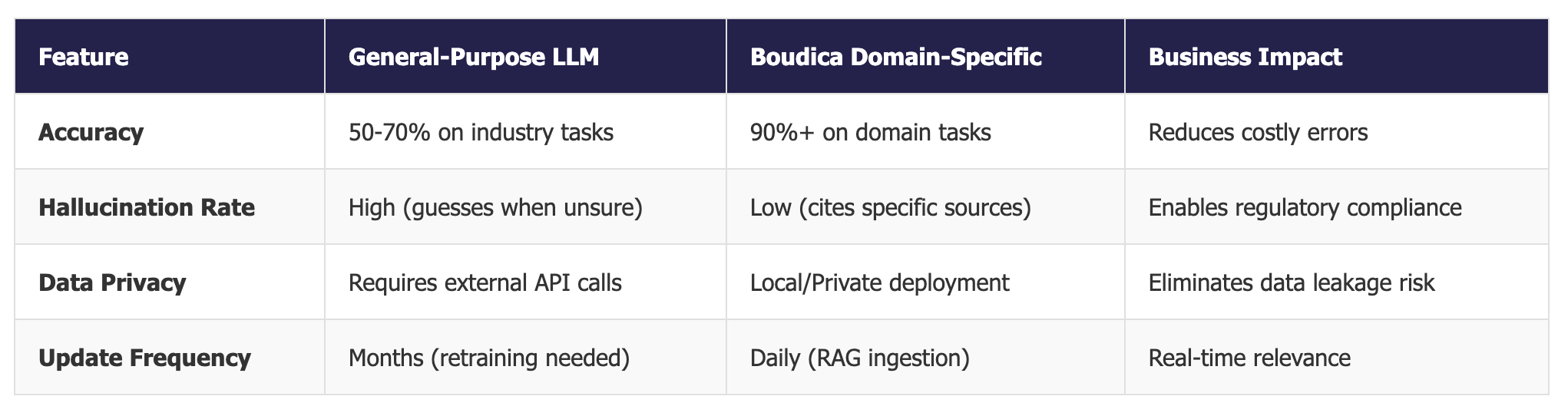
Standard AI Models are trained on the public internet. While powerful, these generic tools lack the nuance, terminology, and context required for regulated industries. They suffer from hallucinations when faced with technical jargon and can't access proprietary data safely.
Domain-Specific, Sovereign, Intelligence
Built specifically for regulated environments, Boudica delivers domain-specific intelligence on-prem for cost-effective, powerful intelligence that your teams can actually use.
Own Your Own Intelligence.
Key Features
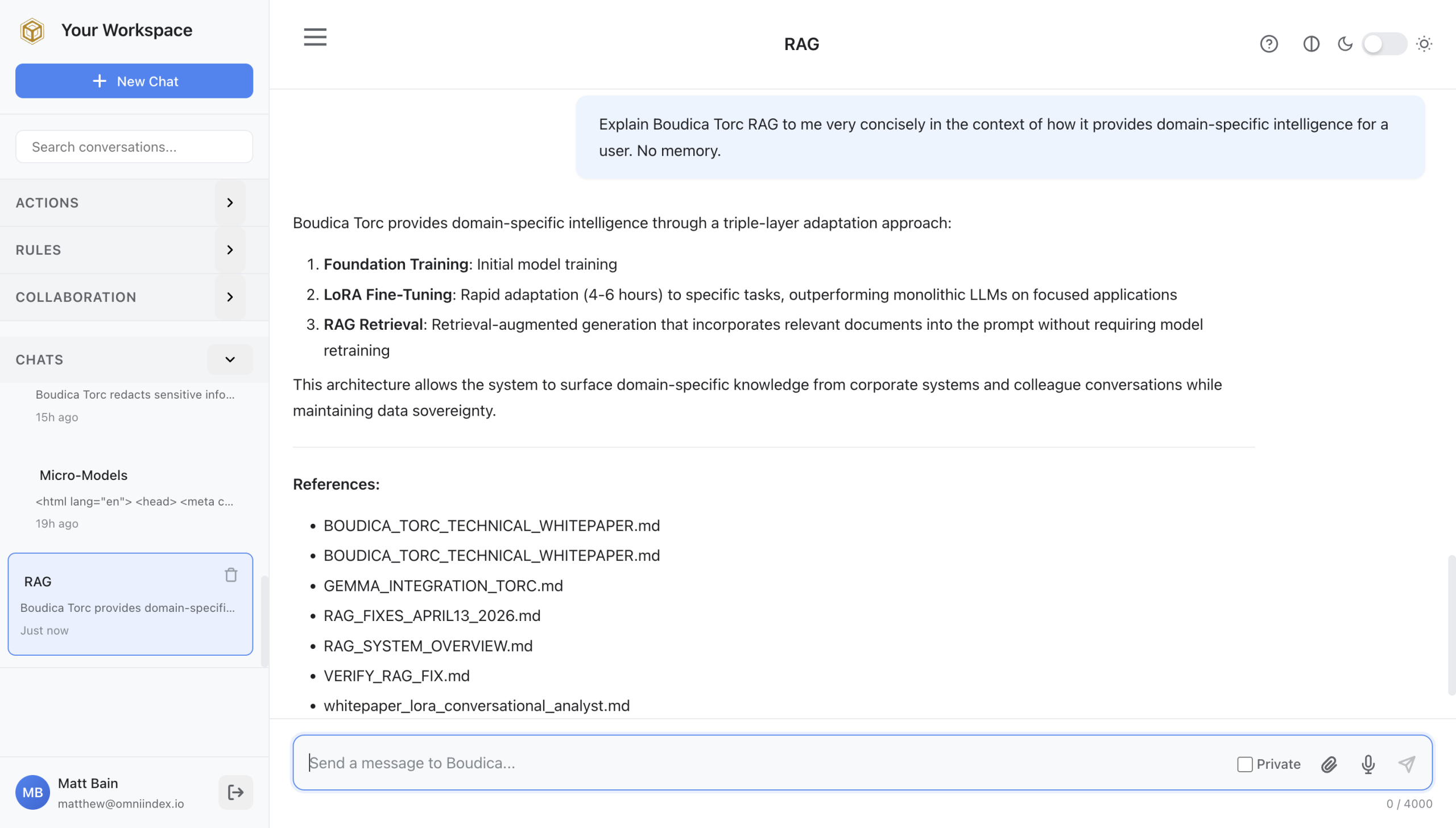
RAG Architecture
Retrieval-Augmented Generation (RAG) connects you to your private knowledge base.
- Vector Search: Semantic search across PDFs, spreadsheets, and databases.
- Context Window: Injects relevant document snippets into prompts.
- Citation Engine: Returns sources for every claim (crucial for audits).
Domain Adaptation
Train or fine-tune models on your industry's technical vocabulary and proprietary documentation. This ensures the AI understands the specific jargon, acronyms, and procedures unique to your organization.
Hybrid Intelligence
Combines structured data access with unstructured text reasoning.
- SQL Generation: Translates questions into database queries.
- Structured Integration: Fetches real-time numbers from ERP/CRM systems and connected databases.
- Unstructured Context: Combines text reasoning with hard data.
01 / Beyond Generic LLMs: Deep Domain Specialization
Generic Models Guess. Boudica Knows Your Business.
Native LoRA Micro-Adapter Tuning
Tailor the core AI model to your organization’s technical terminology, industry jargon, and unique workflows using localized Low-Rank Adaptation (LoRA) fine-tuning.
Triple-Layer RAG Grounding
Answers are anchored directly in your authenticated files using a triple-layer Retrieval-Augmented Generation (RAG) pipeline to ensure click-to-verify citations for every response.
02 / Dynamic Ingestion & Structured Data Sources
Question Live Enterprise Systems and Structured Data Daily
Persistent Analysis Sources
Register standing structured datasets (such as SQL database connections, CSV logs, or code repositories) so teams can query live operational metrics without re-uploading files.
Global OAuth Enterprise Connectors
Connect platform-wide to essential business systems, including Microsoft 365, Google Workspace, GitHub, Jira, Confluence, and CRM platforms with full admin control over access.
Allowlist Web Crawling
Index external documentation, standards, or vendor portals using a strictly controlled URL allowlist, eliminating uncontrolled or risky web scraping.
03 /Departmental Knowledge Isolation & Governance
Multi-Tenant Architecture Built for Complex Enterprises
Unified Domain & Seat Segmentation
Knowledge bases, usage metrics, and permission rules are segmented by department or business unit on a single deployment.
Deny-by-Default Document Visibility
Users only retrieve data from Knowledge Base folders matching their explicit permissions, ensuring HR or financial records remain strictly isolated.
Automated Organizational Agents
Build and publish multi-step, domain-specific workflows such as generating regulatory reports or digesting daily ticket queues to standardize best practices across teams.
All rights reserved © 2026 OmniIndex